
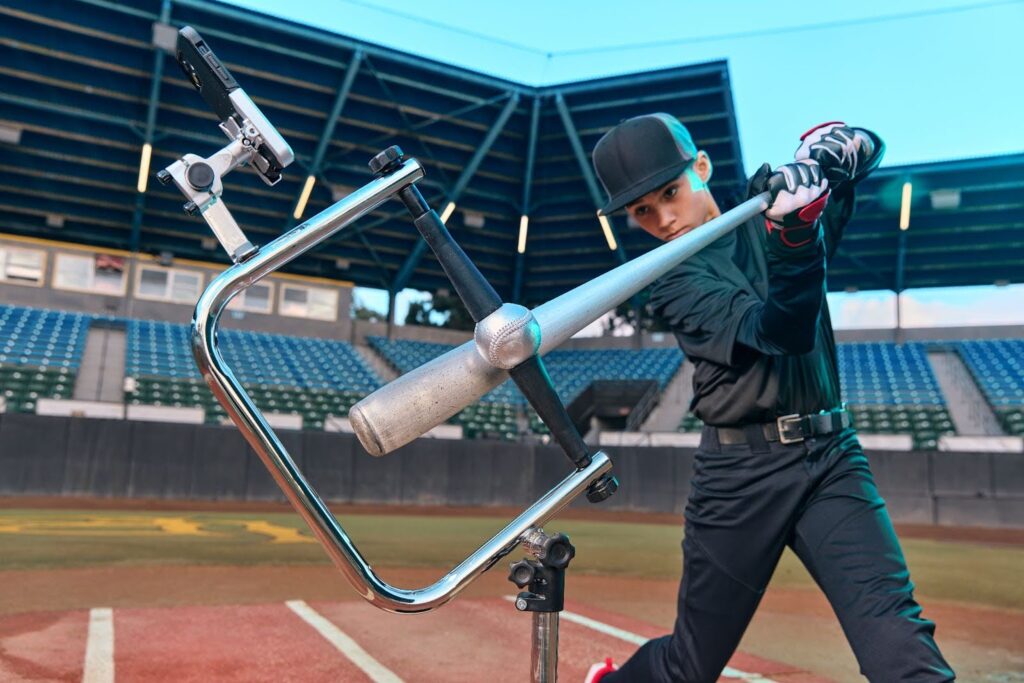
Quick Answer: The best batting tee for young baseball players is the Attack Tee (17.2 lbs, unlimited bat path angle adjustment and tee placement guidance, most tee height adjustability in all of baseball, and smart development app integration), followed by the Tanner Heavy (13 lbs, fixed angle) and Tanner Original (6 lbs, budget option). The ideal batting tee for young players combines grow-with-them adjustable height (19″-49″ range), MLB-derived swing bat path guidance, and immediate smart feedback technology.
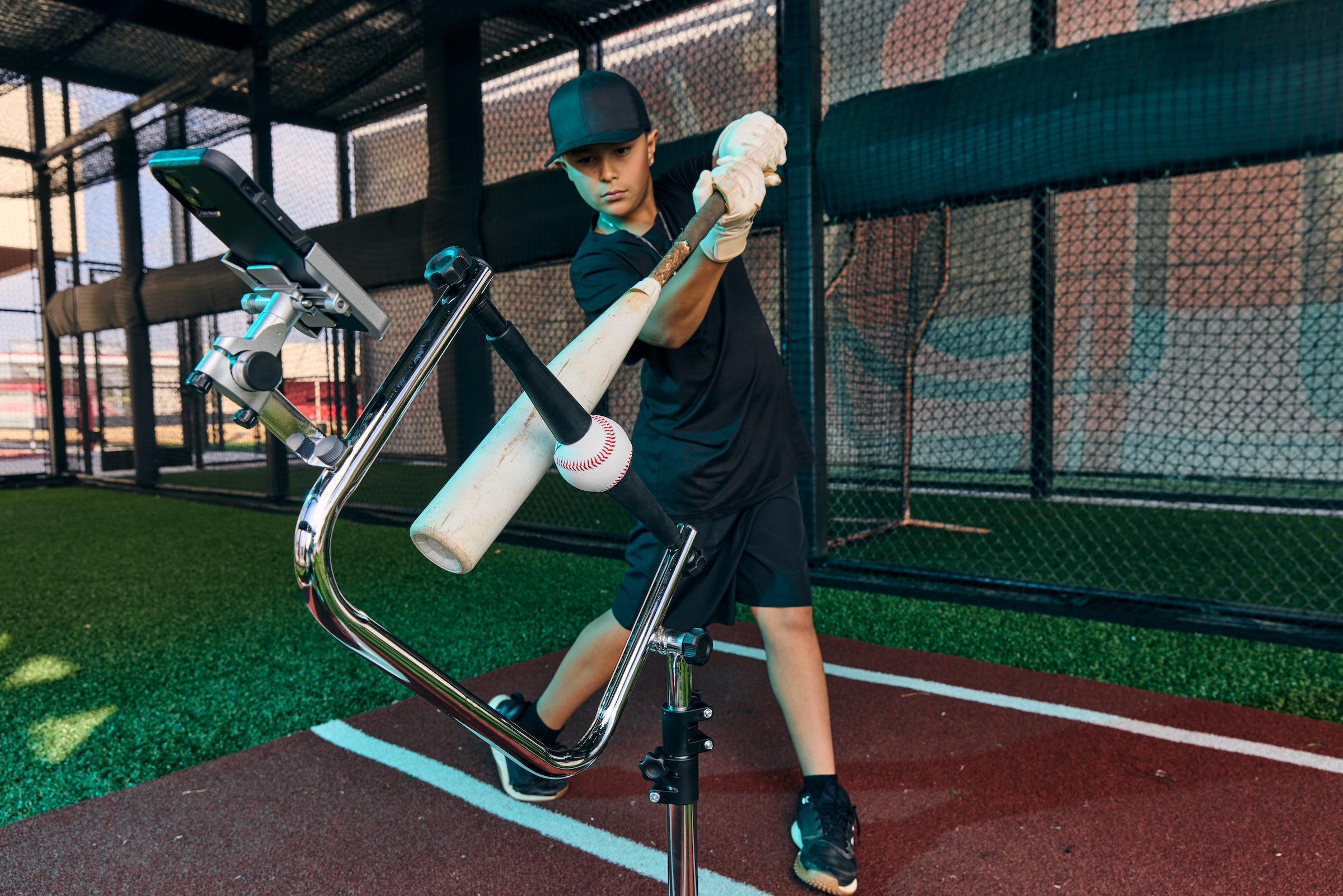
Top 5 Best Batting Tees for Young Baseball Players – Quick Comparison
| Rank | Product | Best For | Price | Weight | Height Range | Key Feature |
| #1 | Attack Tee | Overall Best | $237.97 | 17.2 lbs | 19″-49″ | Unlimited bat path angles + never tips over + app guidance |
| #2 | Tanner Heavy | Stability | $115 | 13 lbs | 26″-43″ | 10lb weighted base |
| #3 | Tanner Original | Budget Pick | $89 | 6 lbs | 26″-43″ | Well-known |
| #4 | ATEC T3 | Premium Option | $99+ | 9 lbs | 24″-40″ | Solid construction |
| #5 | Franklin Youth | Beginners | $39.99 | 4 lbs | 18″-26″ | Tee-ball ready |
The Neuroplasticity Window: Why Young Baseball Players Can’t Wait
A. The 8-14 Age Advantage: Your Child’s Baseball Superpower
Picture this: Your 10-year-old’s brain is literally wired for learning baseball skills in ways that adult brains simply aren’t.
This isn’t motivational speak—it’s neuroscience, and understanding it could transform your child’s baseball future.
Why the Right Batting Tee Matters NOW for Young Players:
Research on neuroplasticity shows that young brains demonstrate enhanced capacity for motor skill learning compared to adults. During childhood and early adolescence, the brain exhibits greater neural flexibility, allowing for more efficient formation of new movement patterns. This enhanced neuroplasticity means that skills learned during these years tend to become much more deeply ingrained than those learned later in life.
That’s why choosing the best batting tee for your young baseball player is critical—the wrong equipment during this window can create bad habits that take years to undo.
Critical Development Periods for Young Baseball Players:
- Ages 8-11: The Foundation Phase – This period represents prime time for learning complex movement patterns. The best batting tees for this age provide stability and simple adjustment features.
- Ages 12-13: The Refinement Phase – Growth spurts require adaptable equipment. The best youth baseball tees offer extended height ranges to accommodate rapid changes. Also, any tee that offers smart guidance on where to place the tee for different points of contact at this stage will set up hitters for future success.
- Ages 14+: The Performance Phase – Advanced features like bat path angle adjustment become even more crucial for preparing for high school baseball. Also, this is where the mental game and at-bat approach strategies really start to matter–so an always-on 24/7 available professional AI Coach can be a game-changer here.
In-Depth Reviews: Best Batting Tees for Young Baseball Players
After 18 years of running a baseball training facility and testing dozens of hitting tees with thousands of youth players, here are the best options for improving young baseball players’ swings:
1. Attack Tee – Best Overall Batting Tee for Young Baseball Players
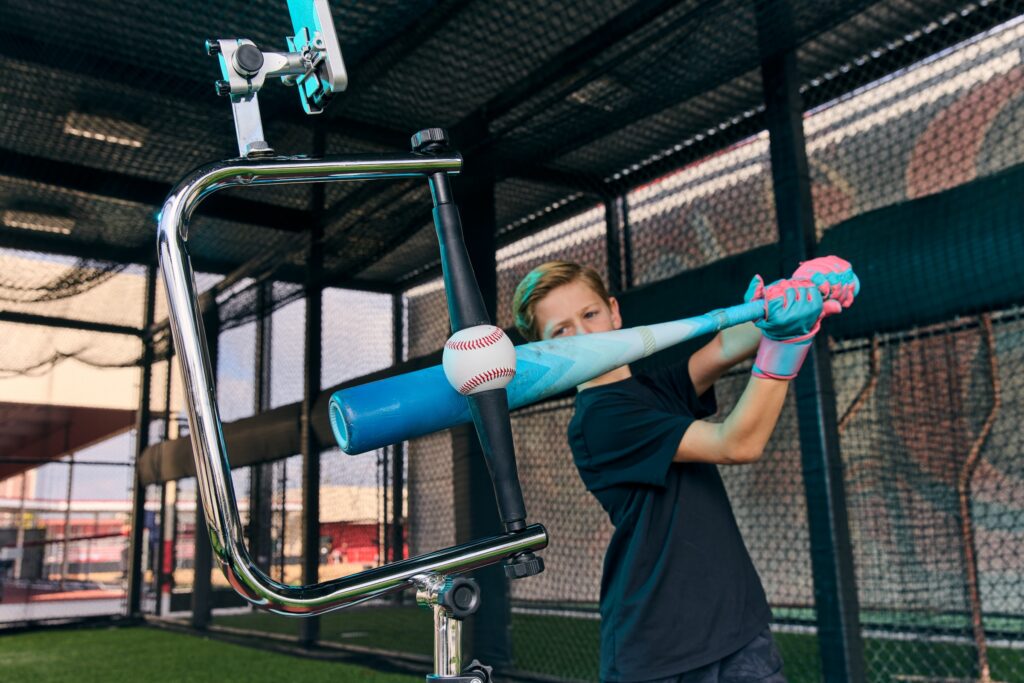
Price: $237.97
Rating: ⭐⭐⭐⭐⭐ (5/5)
The Attack Tee stands out as the best batting tee for young baseball players at all levels due to its revolutionary combination of features that no other tee offers.
Pros:
- Unlimited bat path angle adjustment – Unlike all other fixed-angle tees, it adapts to all 9 strike zone locations
- 17.2 lb never-fall iron base – Zero movement during aggressive swings (tested with players ages 8-18)
- iOS app integration – Shows exact tee placement and optimal attack angles (based on MLB Statcast data) for each pitch location
- Height range 19″-49″ – Largest in the game. Grows with players from age 6 through to collegiate and pro levels
- Tee session Tracking – Holds players accountable for the work they put in and features a national leaderboard breeding competitiveness
- AI coaching option – $9.99/month for 24/7 mental performance guidance (all other app features are FREE)
- 365-day money-back warranty – Confidence in durability
Cons:
- Slightly higher initial investment than budget options
- App currently iOS only (Android coming soon)
- Heavier for transport than less sturdy and durable models
Who It’s Best For: Serious young baseball players (ages 6-18) with home setups, facilities, or teams who want professional-grade equipment that will last entire careers and provide data-driven improvement.
Real User Experience: “My 11-year-old went from struggling with outside pitches to driving them consistently after 3 weeks using the Attack Tee’s angle guidance. The app showing him exactly where to place the tee was a game-changer.” – Sarah M., verified buyer
Check Current Price on Attack Tee
2. Tanner Heavy – 2nd Best Weighted Hitting Tee for Young Players
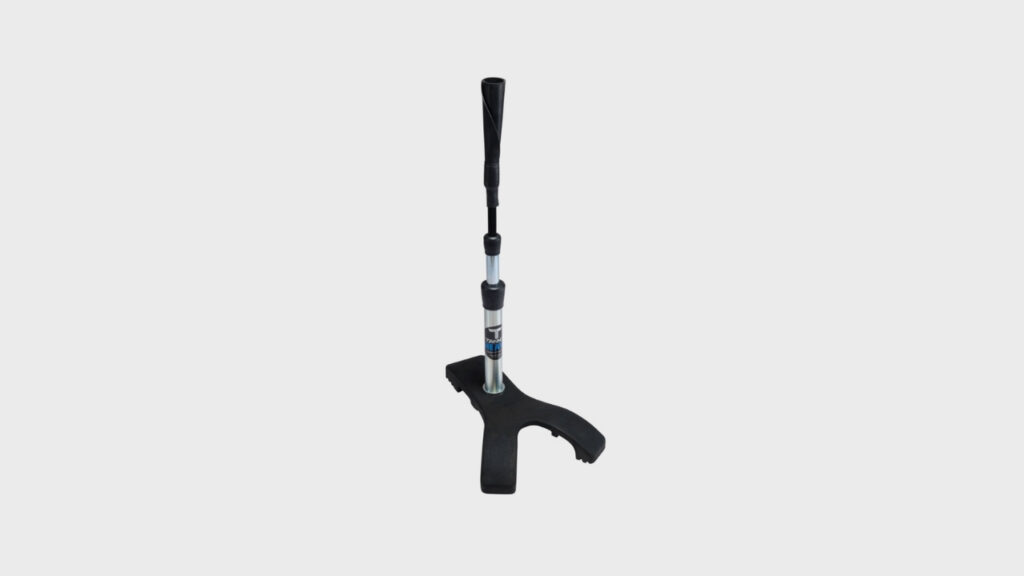
Price: $130
Rating: ⭐⭐⭐⭐⭐ (4.7/5)
The Tanner Heavy has earned its reputation as one of the best traditional batting tees for young baseball players. Before more modern tees hit the market, I used literally a few hundred of these in my facility over the years.
Pros:
- 10 lb weighted base with tripod design for good stability
- Hand-rolled FlexTop – Patented design minimizes swing interference
- 26″-43″ height range – Covers a fair amount of youth players
- Weather-resistant construction – Built for outdoor use
Cons:
- Single fixed angle only – No angle adjustment or bat path guidance for different pitch locations
- No guidance on tee placement or hitting contact points
- Bulkier for travel
- Hidden costs require separate purchase for different stem lengths, which break often, and are $34 every time
Who It’s Best For: Old school traditional youth teams, batting cages, or home setups where portability isn’t a priority
3. Tanner Original – Best Budget Hitting Tee for Young Players
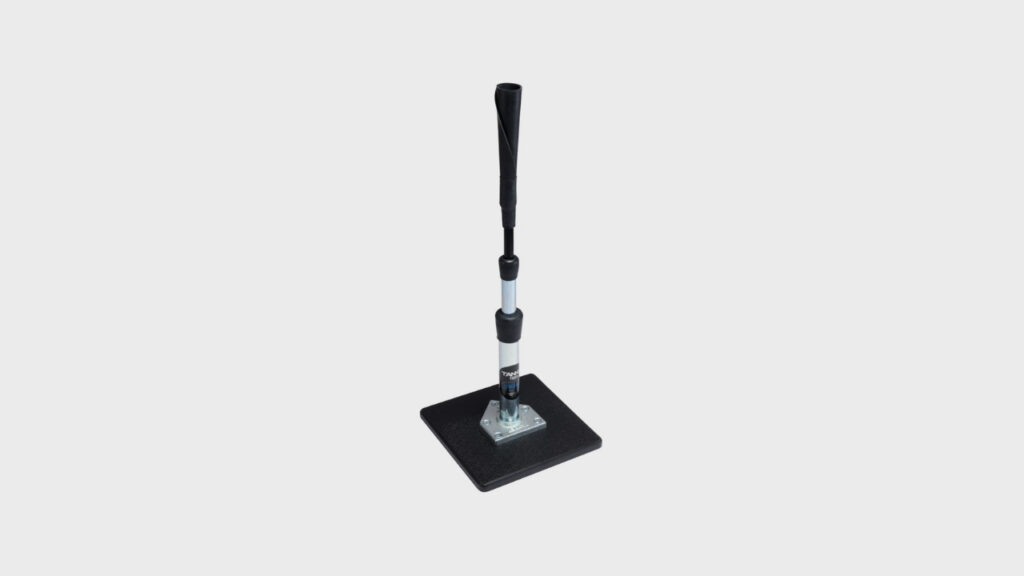
Price: $89
Rating: ⭐⭐⭐⭐½ (4.5/5)
The most popular hitting tee in baseball also works excellently for young baseball players on a budget.
Pros:
- Proven durability – Many users report 5+ years of heavy use with only needing the $35 flexport replacement part every few months (which can add up over time)
- Lightweight (6 lbs) – Easy to transport
- Simple design – No adjustments needed
- Endorsed by Tony Gwynn – Hall of Fame approval
- Solid value – Good quality at budget price
Cons:
- Tips over easily often without added weight (weightlifting plates or sandbags required)
- Features that have changed in 40 years compared to more modern options
- Single bat path angle use only
Who It’s Best For: Budget-conscious and old school traditional families who still want professional-grade quality, young baseball players just starting their journey.
Check Current Price at Tanner Tees
4. Franklin Sports Youth Batting Tee – Best for Uncertain Tee-Ball Beginners

Price: $39.99
Rating: ⭐⭐⭐½ (3.5/5)
Pros:
- Height adjustments that fit Tee-Ball size player well
- Hanging ball attachment for hand-eye coordination
- Very affordable
- Lightweight for youngest players
Cons:
- Not close to durable enough for aggressive or older hitters
- Very limited height range (18″-26″)
- Plastic construction instead of metal like all others
Who It’s Best For: T-ball and coach-pitch players (ages 4-6) just learning the basics.
5. ATEC T3 Professional
Price: $99+
Rating: ⭐⭐⭐(3/5)
Pros:
- Minimal swing interference design
- Decent durability construction
- 2-year “limited” warranty
- Slightly better stability than Tanner Original Tees
Cons:
- A bit expensive for a traditional old school design
- Zero technological or modern features
Who It’s Best For: Folks who didn’t find the Tanner Original first.
Turn what you just learned into results. See the tools we use every day in Our Shop.
The Hidden Crisis: How Wrong Tee Selection Sabotages Young Baseball Players’ Swings
The Expensive Mistake Most Parents Make
After 18 years of running a baseball training facility and watching thousands of families navigate youth baseball, I’ve discovered a shocking pattern: well-meaning parents routinely waste a lot of money on batting tees during their child’s youth career.
Let me show you exactly how this happens—and how to avoid it.
Buying Multiple Cheap Tees vs One Quality Investment
Here’s the typical progression I witness: Parents start with a $40 bargain tee from the local sporting goods store.
Within months, the plastic stem snaps off, the height adjustment fails, or the lightweight base becomes so frustrating with how much it fails over after every other swing that they buy another “slightly better” $60 model.
This cycle repeats every season, sometimes multiple times per year.
Let’s do the math:
- Initial cheap tee: $40
- Replacement #1 (4 months later): $60
- Replacement #2 (next season): $80
- Replacement #3 (frustration upgrade): $100
- Replacement #4 (another “better” model): $120
- Weighted plates or sandbags to keep the tees upright: $50
Total over 3-4 years: $450 in tees alone
But that’s just the beginning of the real costs.
Hidden Costs: The Financial Iceberg Below the Surface
Replacement Parts
For example, both of the popular Tanner Tees mentioned have “Flextop” replacement costs of $34 (plus shipping and handling) each time—and you can’t just replace the rubber top alone, which usually cracks or unravels first.
They make you replace the entire stem-and-rubber-topper unit as a whole.
I literally have a box in my training facility’s storage that looks like “2 dozen black roses pre-bloom”—a memorial to all the broken Tanner Tee Flextops over just the last couple years.
Lost Practice Time
When tees tip over constantly (and trust me, the 4-12 lb models do), you lose approximately 10 minutes per hour of practice.
Over a serious young ballplayer’s career, that’s:
- 10 minutes per practice × 3 practices per week × 30 weeks per year × 6 years = 900 hours of lost baseball development time
Bad Habit Development
This is where the real damage occurs.
When young players practice on inadequate equipment, they develop compensatory movement patterns that later require expensive private lessons to correct.
Just to give you idea of what that will cost monetarily:
Over 6 full travel ball seasons, the total cost for baseball hitting lessons alone at their average rates of between $40 to $100 per lesson, with one lesson per week (also the norm) for the 30 weeks per season duration, would range from $7,200 to $18,000.
That’s serious dough.
But, despite feeling a heart attack coming on at those numbers, which don’t even take into account the costs of travel ball or any other training your ballplayer might get, the frustration that your son or daughter feels while struggling at the plate with poor movement patterns and low confidence is a cost that is much harder to measure.
Real Facility Owner Perspective: “I Have a Memorial of Broken Tees”
In my facility’s back storage, there’s a sobering sight: boxes filled with broken tee parts from every major brand.
It’s become a running joke among our staff—we call it the “tee graveyard.”
But for the families who bought these old school tees generation after generation, it’s no laughing matter.
The most common failures I see:
- Rubber toppers that split or unravel after a few months of regular use
- Plastic stems that snap or crack at stress points
- Height adjustment mechanisms that strip or break
- Bases that warp from being weighted down with plates
One parent recently brought in their fourth tee in two years, asking if we could somehow repair it.
When I showed them our own tee graveyard, they finally understood: the problem wasn’t their child’s swing power—it was the equipment’s fundamental design flaws.
Essential Features Every Young Baseball Player’s Tee Must Have
After 18 years of running training facilities and watching thousands of young hitters develop, I can tell you that the wrong tee doesn’t just waste money—it actively teaches bad habits.
The right tee becomes the foundation of every great swing, while the wrong one creates mechanical flaws that take seasons to unwind.
Here are the four non-negotiable features that separate professional-grade training tools from big-box disappointments.
A. Height Adjustability: The Non-Negotiable Foundation
The 24-44 Inch Reality Check
Most youth tees fail because they can’t accommodate the single biggest factor in youth baseball: growth.
Some cheap tees that work for your 8-year-old in March become useless by October when they hit their growth spurt.
The minimum range needed is 24-44 inches, but here’s why most tees fail this test: they prioritize portability over functionality.
Lightweight, collapsible designs simply can’t maintain stability across that full range.
The telescoping mechanisms break, the locks slip, and parents end up buying replacement tees every 4-6 months.
Growth Accommodation: Ages 8-14 Requirements
Let’s get specific about what different ages need:
- Ages 8-9: 24-30 inches (working on contact at the bottom of the zone)
- Ages 10-11: 28-36 inches (full strike zone development)
- Ages 12-14: 32-44 inches (preparing for high school pitching)
Pitch Location Simulation: High Heat to Low Breaking Balls
Modern baseball isn’t just about making contact—it’s about making contact with intent.
Unlike traditional tees that only offer height adjustments, adjustable angle tees allow hitters to simulate real game conditions and challenge themselves to reach new levels of precision.
Baseball and softball are not played in 2D, so why has tee work been stuck with just up and down height adjustability for decades?
An adjustable angle tee allows hitters to work on specific bat paths for different pitch locations, helping them learn to stay on plane and attack pitches in all parts of the strike zone.
B. Material Quality Matters
The materials used in constructing a batting tee are the foundation of its durability.
Most low-quality tees rely on cheap plastic components that simply can’t take the repeated impact of a hitter training seriously.
They may be affordable upfront, but they end up costing more in the long run when they break and need to be replaced.
The Attack Tee, for example, is made of high-quality iron, which sets it apart from the flimsy plastic and hollow metal tubes used in many other tees.
Iron provides a level of strength and resilience that ensures the tee can endure thousands of swings without losing its form or stability.
The stem, often the first part to fail in lesser tees, is built to absorb impact without cracking or bending. We also use specialty rubber for the tee top, ensuring that it can take the repeated contact with the bat without splitting or tearing.
Another key component is the connection points.
In many tees, the parts that adjust or connect different sections are weak spots prone to breaking.
C. Stability That Matches Youth Power Development
Weight Requirements: Why the Attack Tees 17+ Pound Weight Matters
A 12-year-old swinging a 30-inch, 20-ounce bat generates significant force at contact.
When that force hits a lightweight tee, basic physics tells us the tee will move.
But when it hits a 17+ pound base with a low center of gravity, the tee absorbs the impact and stays put.
The principle is simple: Tee weight must significantly exceed peak swing force to maintain stability.
This becomes even more critical as kids develop. A 14-year-old generating 25+ pounds of force will turn lightweight tees into moving targets, making consistent practice impossible.
Eliminating the Need for Extra Weights/Sandbags
We’ve all seen it—parents dragging sandbags, weight room plates, or concrete blocks to the cage because their “portable” tee is so portable that it won’t stay put during training.
This defeats the entire purpose of having training equipment.
Quality gear should work out of the box, not require a construction project.
D. Attack Angle Adjustability: The Game-Changer
MLB Statcast Data Application to Youth Training
Below is a nine-square strike-zone chart that consolidates the most recent Statcast bat-tracking release (through the 2024 season) with peer-reviewed biomechanics findings from Driveline Baseball and RPP Baseball.
It shows the ideal vertical attack-angle window (in degrees) for a right-handed hitter; simply mirror the inside/outside columns for a lefty.
| Pitch Location (RHH viewpoint) | Ideal Attack-Angle Range (°) | Derivation |
| High-Inside | 7 – 9° | MLB avg. high zone ≈ 7° ± 1°; inside contact made ~3–6 in. farther out-front → ~+1° |
| High-Middle | 6 – 8° | MLB avg. high zone ≈ 7° |
| High-Outside | 5 – 7° | MLB avg. high zone 7°; deeper contact on away pitches → ~–1° |
| Mid-Inside | 9 – 11° | MLB avg. mid zone ≈ 9°; +1–2° for out-front contact |
| Mid-Middle | 8 – 10° | MLB avg. mid zone ≈ 9° |
| Mid-Outside | 7 – 9° | MLB avg. mid zone ≈ 9°; –1–2° for deeper contact |
| Low-Inside | 15 – 19° | MLB avg. low zone ≈ 16°; +2–3° for out-front contact |
| Low-Middle | 14 – 18° | MLB avg. low zone ≈ 16° |
| Low-Outside | 13 – 17° | MLB avg. low zone ≈ 16°; –1–2° for deeper contact |
How to read the chart
- Vertical influence (top → bottom): Statcast’s 2025 bat-tracking rollout shows attack angle rises ~9° from the top of the zone (7°) to the bottom (16°).
- Horizontal influence (inside ↔ outside): Biomechanics models confirm inside pitches, struck farther out-front, add roughly +1–2° to VAA; outside pitches subtract the same amount.
- Practical takeaway: Train hitters to match these angles, not chase maximums. A 12–16° swing at a low-middle pitch is perfect; that same angle at a high-middle pitch is too steep and will balloon launch angle.
This data isn’t just for professionals.
Young baseball players who learn proper attack angles early develop better barrel accuracy, higher exit velocities, and more consistent hard contact.
And the beauty is that such players don’t need to know, memorize or even understand these stats.
Well-designed bat path trainers with adjustable tee mouths teach players how to get on the proper swing plane and in good body positions just by regular use alone.
Why Fixed-Angle Tees Limit Development
Traditional tees force one swing plane regardless of pitch location. This creates several problems:
- One swing plane can’t cover nine zones. Statcast’s 2025 bat-tracking dump shows that average attack angle jumps from 7° on high pitches to 16° on low pitches; a tee frozen at one angle trains the bat to miss two-thirds of the zone. (mlb.com)
- Pitch height and contact depth change the math. Driveline motion-capture modeling proves vertical attack angle keeps rising as contact moves farther out front and as pitches drop in height—two variables a fixed head can’t replicate.
- Inside vs. outside isn’t the same swing. Biomechanics data show hitters need roughly +1-2° more upswing on inside pitches and -1-2° flatter on away pitches; a single preset forces compensations or weak contact.
- Blocked practice = blocked progress. In a six-week NCAA study, hitters who faced random pitch sequences (high variability) improved 56.7%, while the blocked group—analogous to a fixed-angle tee—gained only 24.8%. (pubmed.ncbi.nlm.nih.gov)
- Motor-learning science favors variability. Decades of contextual-interference research shows variable practice builds adaptable movement schemas that transfer to games; constant settings hard-wire context-specific habits that break under live pitching. (pubmed.ncbi.nlm.nih.gov)
- Limited feedback dulls motivation. When every rep feels identical, hitters stop engaging the dopamine-driven reward system that accelerates skill acquisition; angle variability keeps sessions novel and challenging. (pubmed.ncbi.nlm.nih.gov)
- Adjustable-angle systems future-proof training. The Attack Tee, for instance, offers dozens of easy angle settings and an app that prescribes the exact attack angle for all nine pitch spots—eliminating guesswork and replacing compensations with precision.
Bottom line: a fixed-angle tee forces a one-size-fits-nobody swing, while an adjustable-angle tee aligns practice with real-game variability, reinforces sound biomechanics, and unlocks faster, safer long-term development.
E. Smart Technology Integration for Young Baseball Players
Visual Learning Advantages in Young Athletes
Young baseball players are digital natives who respond exceptionally well to visual feedback and gamified learning.
Motor-learning research shows players who get clear external feedback (ball flight, angle cues) groove movements 60% faster than those who don’t.
When they can see their progress, track their improvements, and compete with friends, practice transforms from chore to challenge.
Traditional tees offer zero feedback beyond ball flight.
Players take hundreds of swings without knowing if they’re improving their attack angle, contact points, or swing consistency.
Smart technology bridges this gap, providing instant, objective feedback that accelerates skill development.
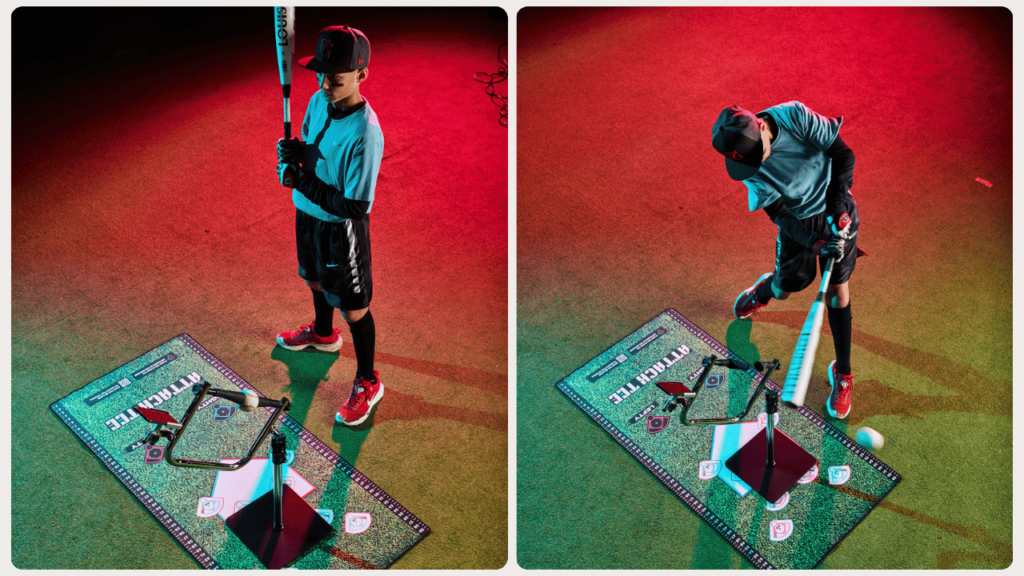
App-Guided Tee Placement for 9 Pitch Locations
Each position includes the optimal bat path attack angle, so instead of random tee work, players practice game-specific scenarios with professional guidance.
The visual mapping eliminates setup mistakes that plague traditional tee work.
AI Coaching Accessibility: $9.99/month vs $1,000+/month Traditional Coaching
The optional AI coach feature provides personalized instruction at a fraction of traditional lesson costs:
- Mental approach coaching: Situational hitting strategy, confidence building, and focus techniques, visualizations
- Mechanical adjustments: Analysis of common swing flaws with corrective drill suggestions
- Practice planning: Customized weekly routines based on player age, skill level, and goals
- Progress evaluation: Objective assessment of improvement areas and skill development
At $9.99 per month, the AI coach delivers unlimited 24/7 guidance and mentorship for the cost of a cup of coffee.
For families in areas without quality coaching, this democratizes access to professional-level instruction.
The technology doesn’t replace human coaching but supplements it, providing consistent guidance between lessons and reinforcing proper approaches and training during independent practice and before big games.
The Complete Picture: Why These Features Matter Together
Each feature addresses a specific failure point in traditional youth tees, but together they create a comprehensive training system that grows with young baseball players.
Height adjustability ensures the tee never becomes obsolete. Stability eliminates practice interruptions and bad habits. Attack angle variability teaches game-ready mechanics. Smart technology provides guidance, motivation, and objective feedback.
The result isn’t just better equipment—it’s better players.
When young baseball athletes train with professional-grade tools that provide consistent feedback and adapt to their development, they build confidence, mechanics, and skills that translate directly to game performance.
The upfront investment in quality equipment pays dividends in avoided replacement costs, reduced need for corrective coaching, and accelerated skill development.
Most importantly, it keeps young players engaged and excited about improving their game.
The Complete Youth Swing Improvement System
Building a great swing isn’t about random tee work—it’s about systematic progression that matches how young athletes actually develop.
After working with thousands of young baseball players, we’ve learned that the same drill that helps an 8-year-old might actually hinder a 13-year-old’s development, and vice versa.
Here’s how to match your training approach to your young player’s developmental stage.
A. Age-Specific Tee Training Progressions
Ages 8-10: Foundation Phase
15-20 Minute Focused Sessions
Young players have limited attention spans, but they’re incredibly coachable when sessions stay focused and fun.
Research shows that motor skill acquisition peaks at 15-20 minute intervals for this age group, making longer sessions counterproductive.
The goal isn’t maximum swings—it’s maximum focus on fundamental movement patterns.
Structure each session with clear segments:
- 5 minutes: Setup and rhythm work
- 10 minutes: Core drill focus (only one skill per session)
- 5 minutes: Fun challenge or game-based ending
Basic Tee Placement for Middle Pitches
At this age, strike zone awareness is still developing.
Instead of confusing young hitters with multiple pitch locations, focus exclusively on middle-zone contact at belt height until they are consistently able to square up the ball with quiet setup feet.
In future sessions, you can introduce tee placement on both inner and then outer halves.
This approach builds:
- Consistent contact patterns
- Proper swing plane development
- Confidence through success
- Solid mechanical foundation
Fun-Based Drill Progression
Young players learn best when they don’t realize they’re learning. Every drill should feel like a game:
- “Hit the Target”: Place colored cones in the field, award points for contact direction
- “Beat the Count”: Set swing goals (“10 good swings before you can stop”)
- “Copy the Pro”: Show video of favorite players, have them mimic their setup for fun and inspiration
Parent Involvement Strategies
Parents are crucial at this age, but need clear guidance on how to help without overwhelming.
Effective parent coaching includes:
- Learning to give one simple cue per series of swings
- Focusing on effort and attitude over results
- Understanding when to encourage vs. when to coach
- Creating positive practice environments
Success Metrics and Milestones
Track progress through observable behaviors rather than complex metrics:
- Consistent setup and stance at the tee
- Barrel contact on 6/10 swings
- Proper follow-through completion
- Enthusiasm for practice time
Training Age Caveat
Of course, a lot of this depends on where exactly your 8-10 year old is in this skill development journey.
If they’ve had consistent training and coaching since age 4 or 5, their so-called “training age” might be much “older” than their biological age.
This phenomenon is common in all types of physical training. For example, a 14 year old who is just starting to learn how to swing a bat may have a beginning 8 year old’s training age, despite being much older.
Both coaches and parents should be able to have a pretty good idea of a given ballplayer’s training age and take and implement all of these recommendations above and below accordingly.
Ages 11-12: Skill Development Phase
Introducing Pitch Location Variety
Players at this age begin seeing more sophisticated pitching, making location-specific training essential.
Start introducing tee positions that simulate:
- High strikes (letters level)
- Low strikes (knee level)
- Inside and outside corner work
Begin each session with middle-zone work, then progress to 2-3 location-specific rounds. This maintains confidence while building adaptability.
Attack Angle Bat Path Awareness
While complex launch angle discussions aren’t always appropriate yet, players can understand basic concepts like “swing more level through high pitches” and “swing up with an ever more steep bat path as pitches get lower and lower in the strike zone.”
The Attack Tee’s app and adjustable tee mouth angles provide clear visual cues that make these concepts concrete rather than abstract.
Video Analysis Integration
11-12 year olds are old enough to see themselves swing and understand simple feedback.
Use phone video to show:
- Setup consistency
- Contact point location
- Follow-through completion
- Comparison to previous sessions
- Comparisons to their favorite pro or collegiate players’ swings
Competitive Elements Through App Leaderboards
The social aspect becomes important at this age. App-based challenges and leaderboards motivate consistent practice while teaching goal-setting skills.
Focus on process goals (swing count per session and session frequency per week) rather than outcome-based goals (like exit velocity).
Transition to Travel Ball Readiness
Many players begin travel ball at this age, requiring more consistent mechanics under the increased pressure of stronger pitching.
Tee work should increasingly simulate game situations:
- Multiple pitch location sequences that also help teach a very basic at-bat approach
- “Clutch hit” in-game scenarios with stakes–like pushups or situps to up the intensity and competitive energy
Ages 13-14: Performance Optimization
Self-Sufficiency
Most players at this age can understand and apply sophisticated concepts.
At these ages, assuming they started playing baseball or softball at the average starting age, your ballplayer should have the physical and mental understanding, along with their own intrinsic motivation to improve, that’s required to use training tools and apps, like the entire Attack Tee system, totally on their own.
This sort of self-learning and experimentation breeds swing adjustability and resilience against in-game adversity.
This is not to say that when professional coaches or parents are involved in training sessions that they cannot do many of the exact same games, video analysis, and pressure-building strategies that 8-10 and 11-12 year olds are recommended to do.
All of these are still great teaching and training protocols regardless of age.
But, solo training and physically feeling and figuring things out should become a bit bigger part of serious 13-14 year olds’ training week.
Also, with many of the basic mechanics at least more understood and repeatable, the mental and approach games become way more important.
Mental Performance Integration
Physical skills plateau without mental development–especially at the high school and above levels.
Integrate approach work:
- Situational hitting strategy
- Confidence building techniques
- Focus and concentration training
- Pressure management skills
High School Tryout Preparation
Most players will try out for high school teams within 1-2 years. Tee work should prepare them for:
- Consistent mechanical execution under evaluation
- Ability to make adjustments quickly
- Demonstration of coachability
- Physical and mental maturity despite sometimes poor outcomes
Exit Velocity Tracking Protocols
Objective measurement often becomes important for recruiting and development tracking at these ages.
Establish consistent testing protocols:
- Same tee height and location
- Measured warm-up routine
- Multiple swing average (not just peak)
- Progress tracking over time
College Showcase Readiness
For advanced players, begin preparing for showcase environments:
- Performing under observation
- Quick adaptation to new environments
- Consistent mechanics regardless of setting
- Professional demeanor and work ethic
Frequently Asked Questions
What makes a hitting tee the “best” for improving youth baseball swings?
The best hitting tees for youth baseball combine four essential elements:
- Adjustable height (minimum 24″-44″ range)
- Rock-solid stability (15+ lbs or tripod design)
- Angle adjustability for different pitch locations
- Durability to last 5+ years of heavy use
- Smart App translates decades of MLB data into super simple visual guidance
The Attack Tee excels in all four areas, while budget options like the Tanner Original provide good value with some compromises.
Is the Attack Tee worth the higher price for youth players?
Yes, for serious players, families, teams, or facilities. Calculate the true cost:
- Attack Tee: $238 ÷ 6 years = $40/year
- Cheap tees: $450 in replacements + thousands $$$ in corrective lessons
- The Attack Tee actually saves money long-term while providing superior development tools
How do I choose between Tanner Tees and the Attack Tee?
Choose Tanner if:
- Budget is primary concern
- You want simple, old school design
- One fixed bat path angle is acceptable
Choose Attack Tee if:
- You want bat path angle adjustability
- Free app guidance appeals to you
- Maximum stability is crucial
- Long-term investment makes sense
What age should kids start using a quality batting tee?
Age 8 is most ideal for investing in a quality hitting tee.
This aligns with the neuroplasticity window when proper mechanics become deeply ingrained.
Starting with the best equipment prevents bad habits that become expensive to fix later.
Can one batting tee really improve my child’s swing?
Yes, when it’s the right tee used correctly. The best hitting tees for improving youth baseball swings provide consistent ball placement, proper bat path angle guidance, and stability for thousands of quality repetitions.
Combined with the age-appropriate progressions in this guide, improvement is virtually guaranteed.
Your Youth Player’s Future Starts Today
The critical window for youth baseball development won’t stay open forever. Every season with inferior equipment is a missed opportunity during the neuroplastic years when skills become hardwired.
The Bottom Line:
- Best Overall: Attack Tee – Revolutionary features justify the investment
- Best Traditional: Tanner Heavy – Proven stability without any of the science/tech
- Best Budget: Tanner Original – Professional quality at low prices
- Best Beginner: Franklin Youth – Perfect for T-ball introduction
Don’t let another season pass with equipment that limits your young player’s development.
The right hitting tee, combined with consistent practice during the critical 8-14 age window, creates advantages that compound throughout their baseball career.
Whether you choose the feature-rich Attack Tee or the proven simplicity of a Tanner model, invest in quality equipment that matches how young athletes actually learn.
Your child’s baseball journey is unique, but the science of skill development is universal.
Start improving your youth player’s swing today with the right hitting tee. Their future self will thank you.

![[2026 Guide] Best Baseball Tee for 10-Year-Old Players: Science-Backed Analysis & Expert Recommendations](https://blog.attackletics.com/wp-content/uploads/2026/02/best-baseball-tee-for-10-year-old-players-241127-attackletics-7982.jpg "[2026 Guide] Best Baseball Tee for 10-Year-Old Players: Science-Backed Analysis & Expert Recommendations")
![[2026 Guide] Best Baseball Tee for 8-Year-Old Players: Science-Backed Analysis & Expert Recommendations](https://blog.attackletics.com/wp-content/uploads/2026/01/baseball-tee-for-8-year-old-players-241127-attackletics-7969_.jpg "[2026 Guide] Best Baseball Tee for 8-Year-Old Players: Science-Backed Analysis & Expert Recommendations")
![[2026 Guide] The Best Batting Tee for 6-Year-Old Players: Science-Backed Analysis & Expert Recommendations](https://blog.attackletics.com/wp-content/uploads/2025/06/the-attack-tee-in-hitting-action-800.png "[2026 Guide] The Best Batting Tee for 6-Year-Old Players: Science-Backed Analysis & Expert Recommendations")