After spending nearly two decades operating a premier baseball & softball training facility and personally observing the development of over 5,000 young hitters, I’ve witnessed how equipment choices can either accelerate or derail a player’s progress.
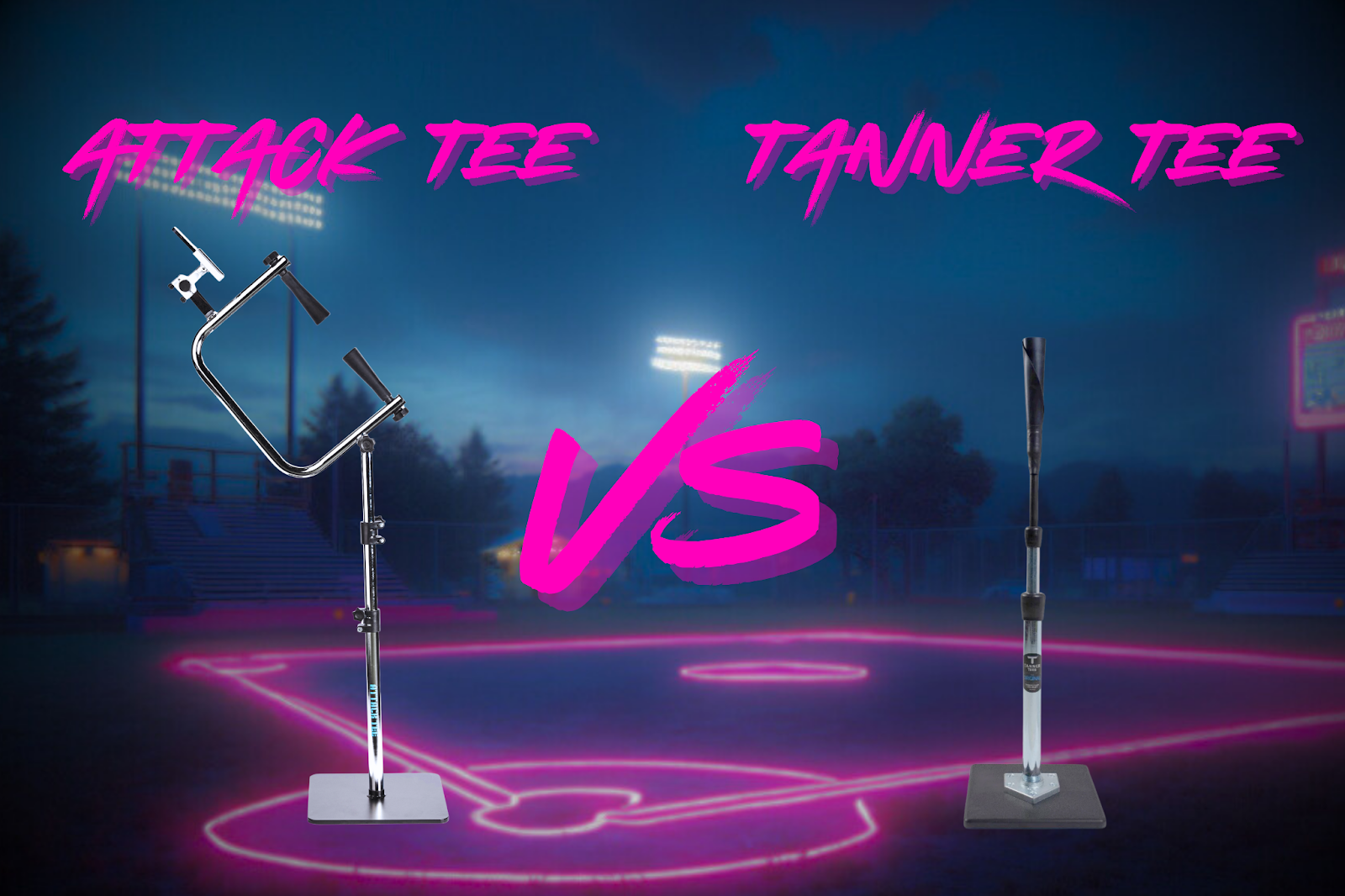
Today, I’m breaking down the industry’s most important debate: whether to invest in the time-tested Tanner Tee or the technologically advanced Attack Tee.
The Stakes: Why Your Batting Tee Choice Matters More Than You Think
Before diving into specifications, let me share what most equipment reviews won’t tell you: selecting the wrong batting tee isn’t just a minor inconvenience—it’s a developmental setback that compounds over time.
I’ve watched families cycle through inferior equipment, spending upwards of $500 on replacements while their young athletes develop compensatory swing mechanics that require thousands of dollars in private instruction to correct.
Meanwhile, those who invested wisely from the start saved money and watched their players flourish.
Complete Specifications Breakdown: Attack Tee vs Both Tanner Models
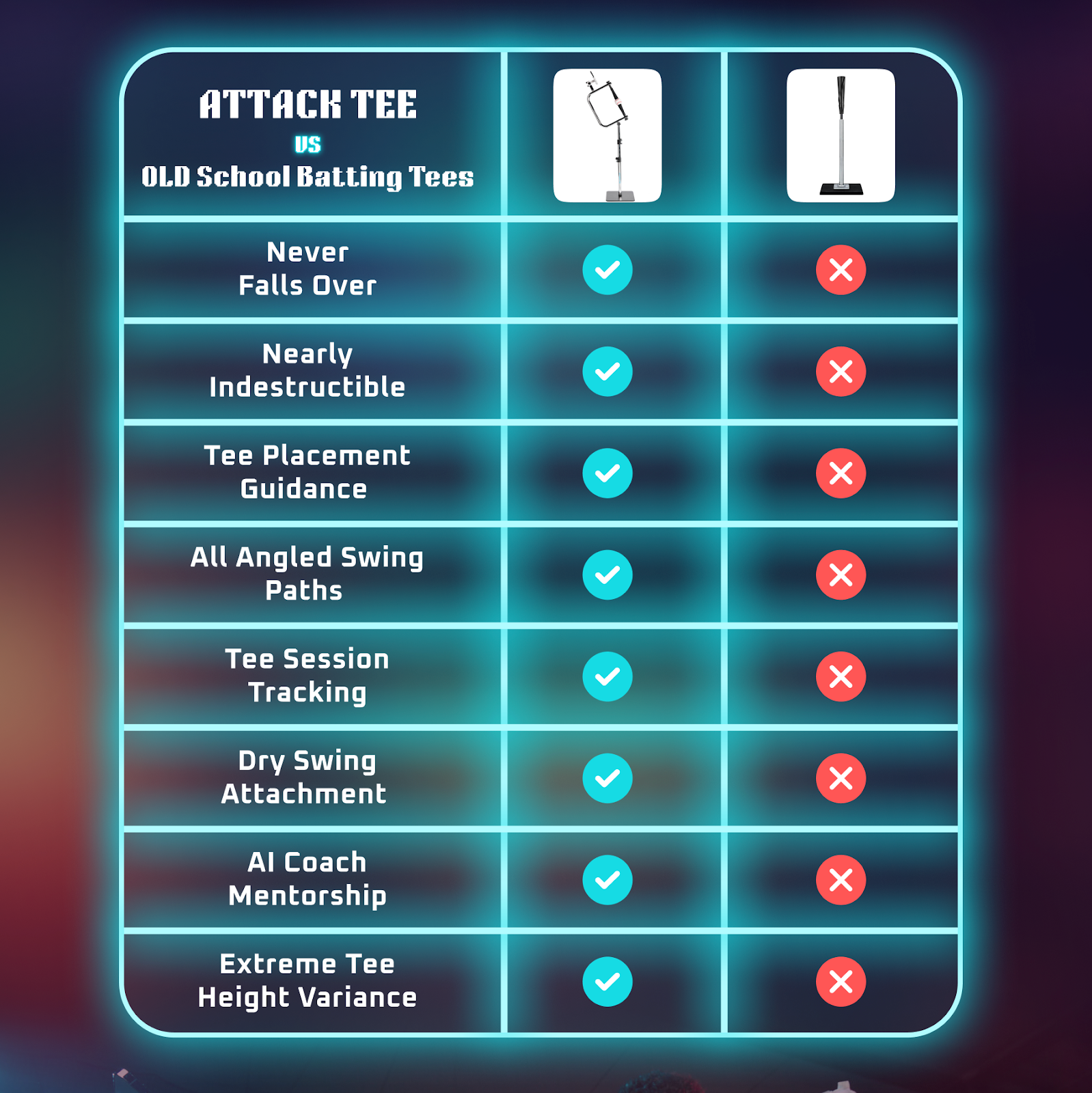
| Specification | Attack Tee | Tanner Heavy | Tanner Original |
| Investment | $237.97 | $115 | $89 |
| Foundation Weight | 17.2 lbs | 10 lbs | 6 lbs |
| Operational Height | 19″-49″ | 26″-43″ | 26″-43″ |
| Swing Plane Versatility | Fully Adjustable | Static | Static |
| Digital Training Platform | iOS Application | None | None |
| Replacement Coverage | 365-Day Guarantee | Standard Limited | Standard Limited |
| Replacement Part Cost | None During Warranty | $34 FlexTop | $34 FlexTop |
Critical Performance Categories: Where Each Tee Excels (And Falls Short)
1. Height Versatility: The Career-Long Investment Factor
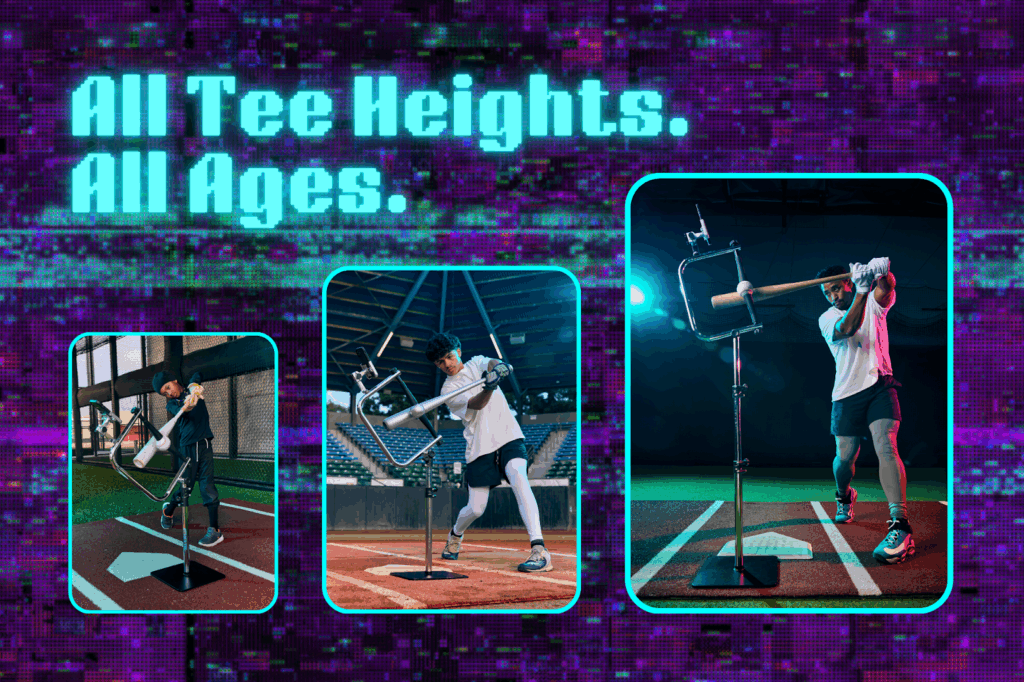
Attack Tee’s 30-Inch Advantage (19″-49″)
The Attack Tee’s industry-leading (by far) adjustment range isn’t marketing fluff—it’s practical engineering that eliminates age-based equipment turnover.
Here’s the developmental reality:
- Tee-ball beginners (ages 5-7): Utilize the 19″-26″ zone for fundamental contact training
- Youth league players (ages 8-10): Work within 24″-34″ for comprehensive zone coverage
- Travel ball competitors (ages 11-13): Develop power through the 30″-40″ spectrum
- High school prospects (ages 14-18): Master the complete 35″-49″ range for varsity preparation and beyond
Tanner’s Traditional Range (26″-43″)
Both Tanner variations provide identical adjustment parameters, creating practical limitations at developmental extremes. Young beginners struggle with the 26″ minimum height, while maturing players max out the 43″ ceiling—particularly problematic when training for elevated fastballs that dominate modern pitching.
During facility sessions, I regularly observe high school and college players stacking Tanner tees on chairs and buckets just to reach realistic pitch upper zone heights—a workaround that shouldn’t be necessary with premium equipment.
Verdict: Attack Tee’s extended range eliminates the multi-tee purchasing cycle, providing genuine cradle-to-college functionality.
2. Foundation Stability: Engineering Meets Biomechanics
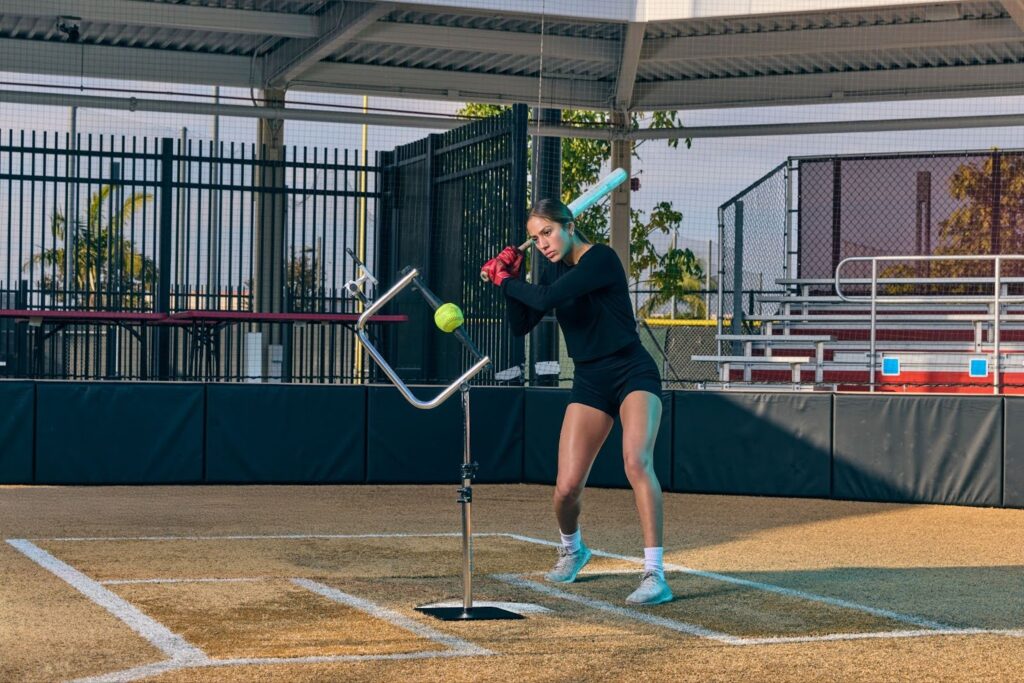
Attack Tee: 17.2-Pound Physics Advantage
When adolescent hitters generate 20-30 pounds of rotational force through contact, Newton’s famous laws become immediately relevant.
The Attack Tee’s cast-iron foundation creates an immovable training platform through:
- Mass distribution that exceeds typical youth swing forces by 300%
- Ground-level weight concentration preventing tipping moments from ever occurring
- Zero-movement contact absorption enabling rhythm maintenance
Tanner Heavy: Mid-Range Compromise at 10 Pounds
The 10 lb weighted tripod configuration provides adequate resistance for most hitters’ miss-swings. The triangulated base design also helps, but lateral forces can still create unwanted movement.
Tanner Original: Portability Over Performance at 6 Pounds
While transportation becomes almost effortless with the Tanner Tee Original version, the lightweight construction necessitates pretty constant repositioning.
If going the Tanner Tee Original route, you’ll need to fix the tipping over issues by using dumbbells or sand bags.
These items are the most common items to keep these tees upright. They can be cumbersome to purchase and carry around in addition to the tee though.
In my own approved facility tests with teams, I’ve catalogued footage showing players spending 8-12 minutes per hour simply resetting tipped over Tanner Tee Originals—that’s 15% of practice time lost to equipment inadequacy. And it kills the rhythm of training sessions.
Verdict: Attack Tee’s substantial foundation transforms chaotic training into focused development, while lighter alternatives require constant supplemental weighting.
3. Revolutionary Angle Dynamics: Where Modern Training Diverges
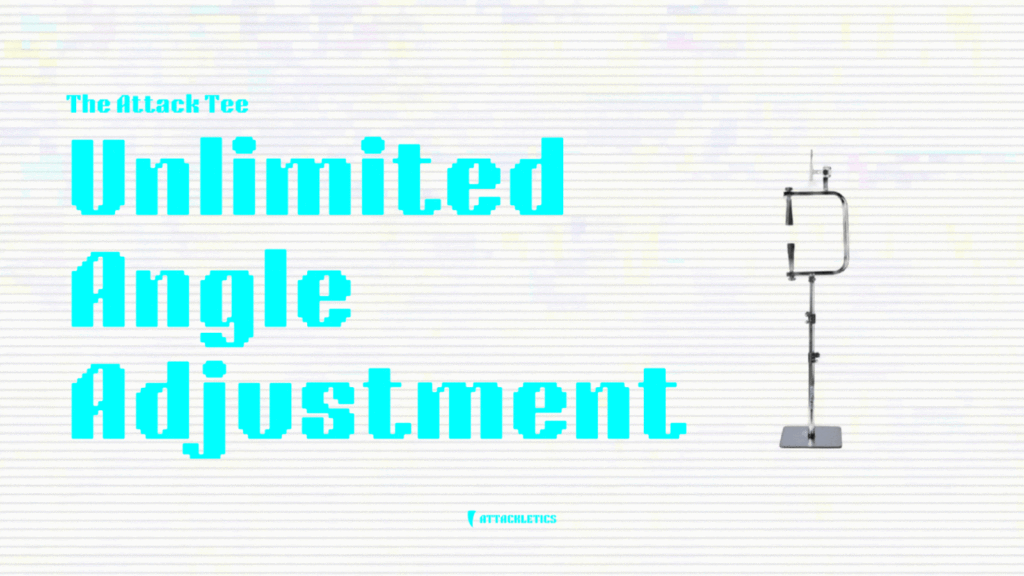
Attack Tee: Multi-Dimensional Swing Path Development
This represents the fundamental paradigm shift between legacy and contemporary training methodology.
Based on comprehensive MLB Statcast analysis from 2024-2025:
- Upper zone strikes: Optimal 6-9° upward path
- Belt-high deliveries: Efficient 8-11° attack trajectory
- Lower third pitches: Productive 13-25° launch approach
The integrated free iOS platform translates this professional data into easy to use and actionable youth training, eliminating guesswork while teaching zone-specific barrel paths that mirror game requirements.
Tanner Tee Models: Single-Plane Limitation
Traditional perpendicular positioning does nothing to guide swing mechanic variations across the different pitch locations hitters really face—a fundamental mismatch with baseball and softball three-dimensional reality.
This 1-dimensional tee constraint creates:
- Guessing on swing adjustments for each pitch height variation
- No intrinsic differentiation between inside and outside pitch approaches
- Stagnant motor pattern development from a single repetitive angle
Verdict: Attack Tee’s adjustability transforms mechanical training from generic to game-specific, while fixed designs perpetuate one-size-fits-none approaches.
4. Ball Holder Innovation: Beyond Traditional Rubber Cups
Attack Tee’s Biomechanical Guide System
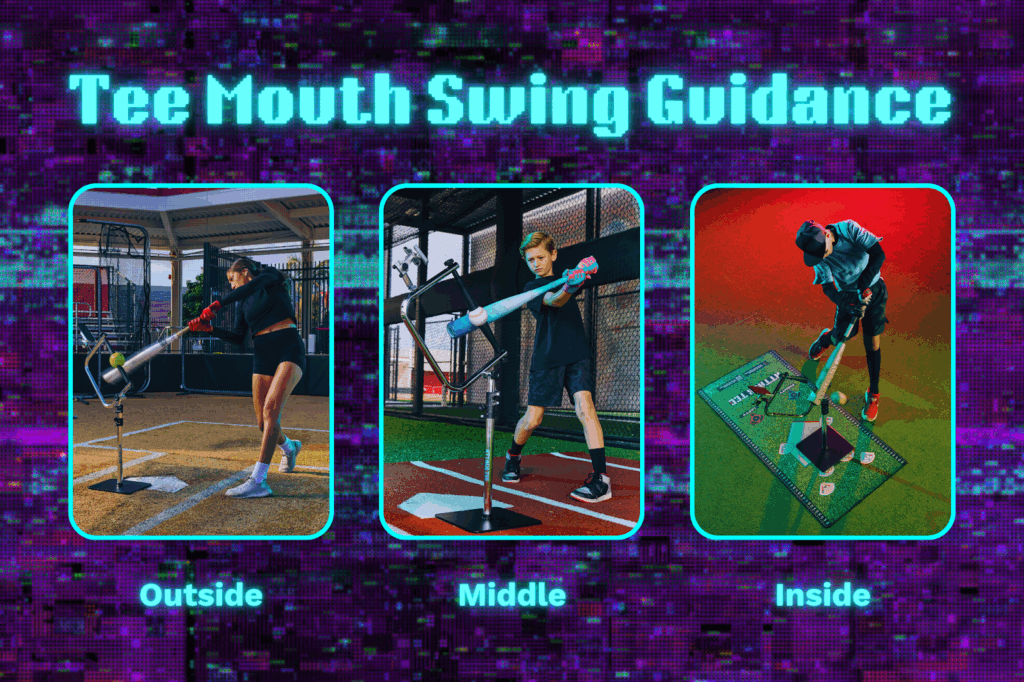
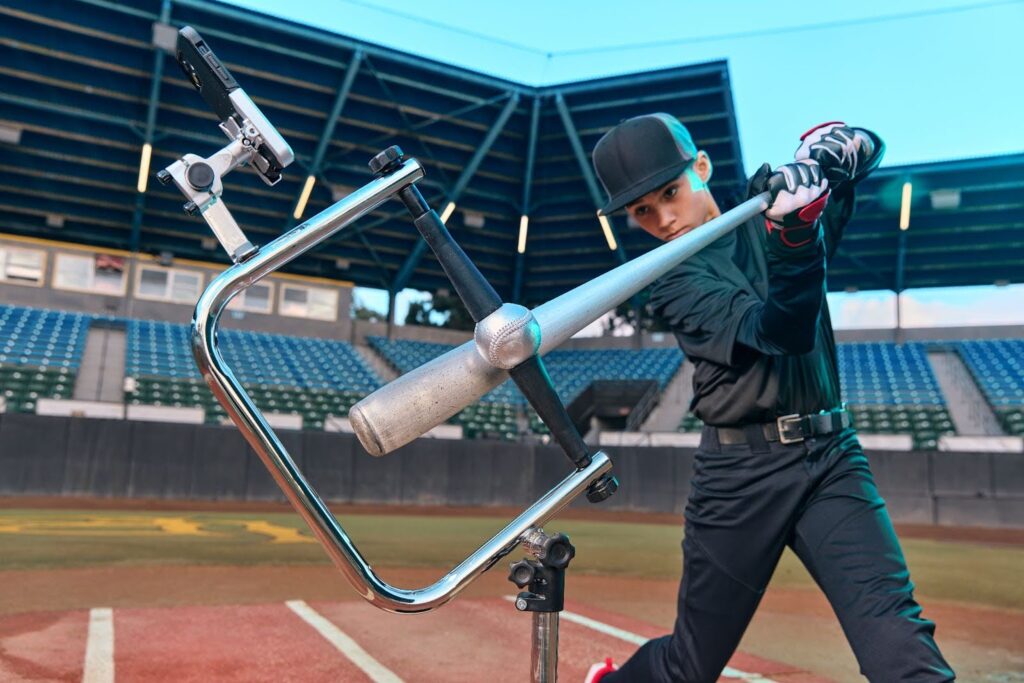
Following extensive prototyping through dozens of iterations, Attack Tee developed a holder design that naturally channels optimal swing mechanics through:
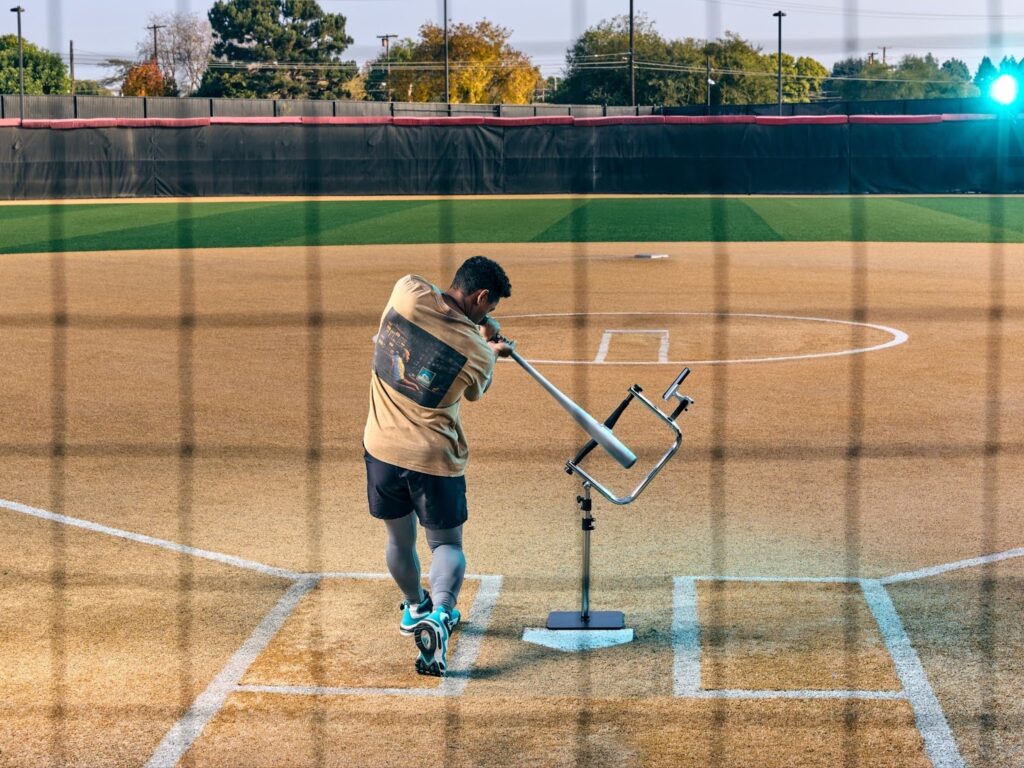
- Directional pivoting capability: Physical and visual guidance for opposite-field and pull-side training, because the tee mouth easily pivots left and right.
- Plane-matching architecture: The tee mouth and its angles planes cause hitters to make organically correct mechanical adjustments without even thinking about it
- Early connection reinforcement: Promotes getting on-plane sooner and staying through contact longer
The Attack Tee also comes with a free dry-swing attachment piece.
This innovation lets hitters train their swing literally anywhere, with no balls or netting required. It is great for at-home training setups, or as a perfect hitting station at team practices who are a bit short on coaching staff.
Tanner’s Heritage Design
The FlexTop system, while durable, represents otherwise unchanged technology from mid-20th century designs. The static positioning provides no mechanical feedback beyond ball flight, missing opportunities for smart and auto-corrective skill development through better equipment.
Verdict: Attack Tee’s holder and tee mouth system actively participates in skill development, while traditional designs remain passive ball supports.
5. Digital Integration: Bridging Equipment and Expertise
Attack Tee’s Comprehensive Training Ecosystem
The complementary and free iOS application transforms solitary and tedious tee repetition into smart guided skill acquisition:
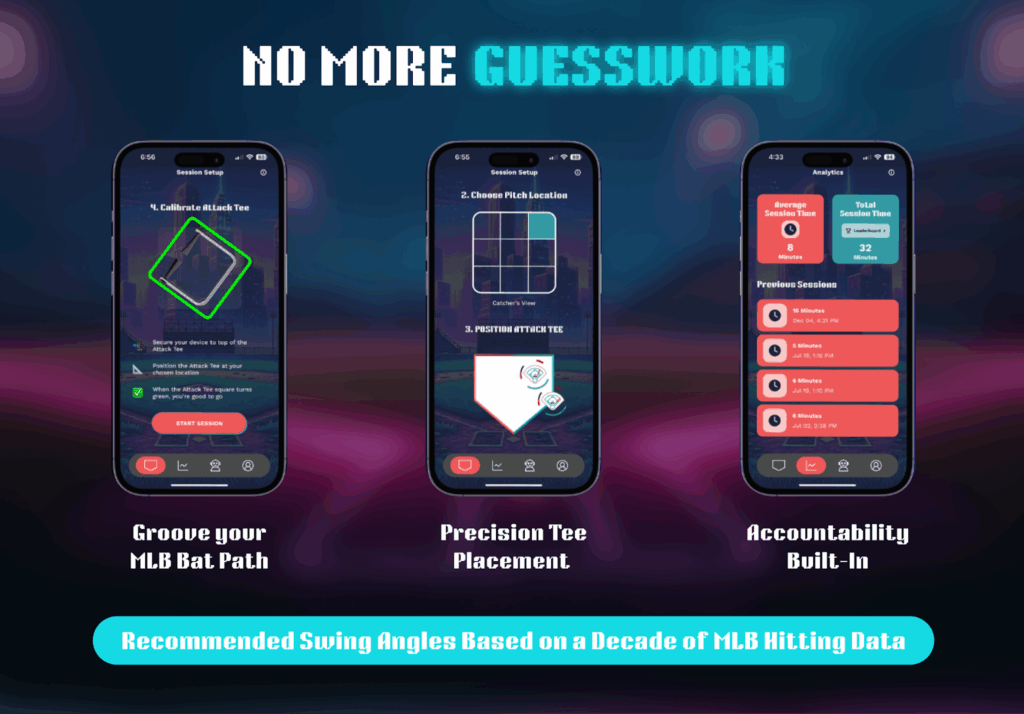
Choose righty/lefty, tap a pitch location you want to train, and the app shows hitters the exact tee placement relative to home plate (so they know the best points of contact) and the app also shows MLB-informed ideal bat path angles for each pitch location based on a decade of Statcast data.
The app also tracks tee session times, because what gets measured gets managed. And hitters should know how much work they’re putting into their swing.
This built-in accountability also gives hitters a mental edge in knowing they’ve done their homework when inside that batter’s box.
Finally, the free app does have one paid feature, an optional AI mental game and hitting approach coach for $9.99/month.
Trained on millions of data points from the world’s best coaches, sport psychologists, and performance scientists, it offers professional coaching accessibility and guidance all day, anywhere, anytime for the monthly price of a single Starbucks coffee with the works.
This additional tech addresses youth baseball and softball’s coaching crisis—quality instruction remains geographically and financially inaccessible for many families. It allows youth hitters training solo in their backyard or garage to remove all guesswork and groove elite mechanics and mindsets.
Tanner’s Analog Approach
Only the ball’s trajectory provides valuable information for experienced players but offers minimal guidance for developing athletes learning proper mechanics.
Verdict: Attack Tee democratizes professional instruction through technology, while Tanner maintains traditional self-directed training.
The Financial Mathematics: True Cost Analysis Over 6 Years (Average Serious Ballplayer Career)
Scenario A: The Budget Tee Spiral
- Starter tee purchase: $40
- Second tee (6 months): $60
- Third upgrade (year 2): $80
- Fourth replacement (year 3): $100
- “Premium” upgrade (year 4): $120
- Stability accessories (weights/sandbags): $50
- Cumulative expense: $450+
Scenario B: Tanner Investment Pattern
- Initial Tanner Original/Heavy: $89-115
- FlexTop replacements (every few months @ $34 each): $408
- Potential full replacement (year 4): $89-115
- Cumulative expense: $586-638
Scenario C: Attack Tee Single Purchase
- One-time investment: $237.97
- Warranty period coverage: Included
- Cumulative expense: $237.97
The premium option paradoxically becomes the budget choice through longevity.
Developmental Consequences: The Hidden Training Tax
Mechanical Contamination from Less-Thought-Out Equipment
When developing athletes train with unstable, limited-adjustment tees, they unconsciously develop:
- Deceleration patterns: Slowing swings to prevent tipping
- Plane compensation: Artificial bat path adjustments due to fixed angles
- Confidence erosion: Frustration from constant rhythm interruptions
Professional correction for ingrained mechanical flaws typically requires:
- Weekly private instruction: $40-100 per session
- 30-week seasons: $1,200-3,000 annually
- Full 6-season player career remediation: $7,200-18,000 total
Time Efficiency Calculations
Equipment-related practice interruptions compound dramatically:
- 10 minutes lost per session (repositioning/adjusting fallen over tees)
- 3 sessions weekly × 30 weeks × 6 years
- Total: 900 hours of lost development time
That’s equivalent to losing an entire year of focused training.
Professional Facility Owner’s Perspective: The Equipment Graveyard Reality
My facility’s storage area contains what staff members darkly muse as the “tee cemetery”—boxes overflowing with fractured stems, split rubber tops, and stripped adjustment mechanisms from every major manufacturer.
Most frequent failure points across brands:
- Rubber components splitting at stress concentrations (3-4 months average)
- Plastic stems fracturing at connection points (6-8 months)
- Height mechanisms stripping under load (8-12 months)
- Base deformation from supplemental weighting (12-18 months)
The Attack Tee notably absent from this collection despite thousands of reps in the facility.
The Professional’s Verdict: Investment Hierarchy
After two decades of equipment evaluation and player development, the hierarchy becomes clear:
For Serious Development: Attack Tee represents batting tee evolution—combining mechanical innovation, technological integration, and engineering superiority into a comprehensive training system. The $238 investment returns exponentially through avoided replacements, eliminated correction costs, and accelerated skill development.
For Moderate Commitment: Tanner Heavy provides reliable traditional training at reasonable cost, though expect ongoing FlexTop expenses and eventual replacement needs.
For Casual Participation: Tanner Original offers proven basics for introductory players, understanding limitations in stability and longevity.
Critical Decision Framework
Choose Attack Tee When:
- Player demonstrates serious commitment (year-round training)
- Development spans multiple seasons ahead
- Technology-enhanced learning appeals to your athlete
- One-time investment philosophy aligns with family values
- Professional-grade home training matters
- Mechanical precision trumps equipment cost
Choose Tanner Tee When:
- Budget constraints absolutely prevent higher investment
- High portability outweighs all other factors
- Traditional old style training methods satisfy coaching philosophy
- Player participation remains uncertain
Final Analysis: The Equipment That Grows With Your Player
The Tanner Tee vs Attack Tee decision ultimately reflects your player’s trajectory. Tanner maintains its reputation through decades of good service, but “good” no longer suffices in competitive youth baseball.
The Attack Tee doesn’t just represent equipment advancement—it embodies training evolution. Through angle adjustability that mirrors game reality, stability that enables aggressive development, technology that democratizes professional instruction, and durability that eliminates replacement cycles, it transforms repetitive and guesswork-heavy tee work into purposeful skill development.
For families navigating youth baseball’s escalating competitive landscape, the Attack Tee provides the foundation for sustainable success.
Ready to revolutionize your training? Get the Attack Tee here and discover why modern players are abandoning traditional limitations for adjustable-angle advantages.
Comprehensive FAQ Section
Q: Can the Attack Tee’s technology really replace professional hitting instruction?
The app supplements but doesn’t replace quality coaching. It provides 24/7 reinforcement of proper mechanics, visual learning aids, and objective progress tracking that enhances any coaching program. Think of it as having an assistant coach available whenever you practice.
Q: How quickly do players typically see improvement with angle-adjustable tees?
Based on facility observations, players demonstrate measurable barrel control improvements within 2-3 weeks of consistent angle-varied training. The ability to practice specific attack angles for different zones accelerates pattern recognition and mechanical adjustment.
Q: What’s the learning curve for the Attack Tee’s app features?
Most players navigate the interface intuitively within one session. The visual strike zone overlay makes setup foolproof, while automatic angle recommendations eliminate complexity. Parents often report their kids teaching them the app features.
Q: Do professional players actually use adjustable-angle tees?
Increasingly, yes. MLB organizations are incorporating variable-angle training into development programs, recognizing that fixed-plane practice doesn’t translate to game performance. Several Triple-A facilities now use Attack Tees exclusively.
Q: How does the 365-day warranty actually work?
Full replacement or refund for any manufacturing defect or performance issue within one year. No complex RMA process—direct customer service resolution. This confidence comes from minimal warranty claims despite thousands of units sold.
Q: What age should kids start using a quality batting tee?
Age 8 is most ideal for investing in a high quality hitting tee. This aligns with the neuroplasticity window when proper mechanics become deeply ingrained.
Starting with the best equipment prevents bad habits that become expensive to fix later.
Q: Can one batting tee really improve my child’s swing?
Yes, when it’s the right tee used correctly. The best hitting tees for improving youth baseball swings provide consistent ball placement, proper bat path angle guidance, and stability for thousands of quality repetitions.
Combined with the age-appropriate progressions in this guide, improvement is virtually guaranteed. The Attack Tee, by contrast, has shown remarkable durability across hundreds of players over multiple seasons.